ruins near the monastery
Interview with the VampireThe ruins near the monastery in Transylvania are a remote, decaying monastic site that becomes the decisive setting of Louis and Claudia’s Eastern European vampire quest. Reached through a dangerous landscape and entered at night, the ruins promise access to the ancient knowledge of their kind but instead reveal a mindless, decomposing revenant. The encounter transforms the location from a possible sanctuary of origins into evidence of vampiric degeneration and deepens Louis’s despair about immortality.
Origin of the Quest
Louis and Claudia travel toward central Europe because Claudia believes that the vampires of the Old World may explain their origins and teach them how creatures like themselves came into being. She studies accounts by priests and scholars describing vampires in Eastern Europe, including the practices used by villagers to destroy them: staking the heart, severing the head, and burning the remains. Their planned route carries them toward the Black Sea, Varna, and the rural Carpathians, where the legends of the living dead seem most persistent.
The monastery is part of this itinerary because it is said to be a remarkably preserved ruin in the countryside. Morgan and Emily, an English couple traveling on their honeymoon, had originally come to the region to visit it while Morgan painted the scenery. They never reached it. Emily was killed, and Morgan’s account of the village’s treatment of a supposedly resurrected corpse becomes the immediate warning that draws Louis and Claudia toward the ruins. The place therefore enters the narrative first as a destination of picturesque travel and archaeological curiosity, then as the center of a vampire legend whose violence has already claimed human witnesses.
Approach Through the Wilderness
After learning that Emily is endangered and that the villagers associate the region with vampires, Louis and Claudia leave the isolated inn and drive toward the monastery. Claudia is impatient and determined, urging Louis to use the whip and striking at branches that dip into the carriage lamps. Louis, by contrast, is haunted by Morgan’s grief and by the expectation that the creature responsible for Emily’s fate may be one of their own kind.
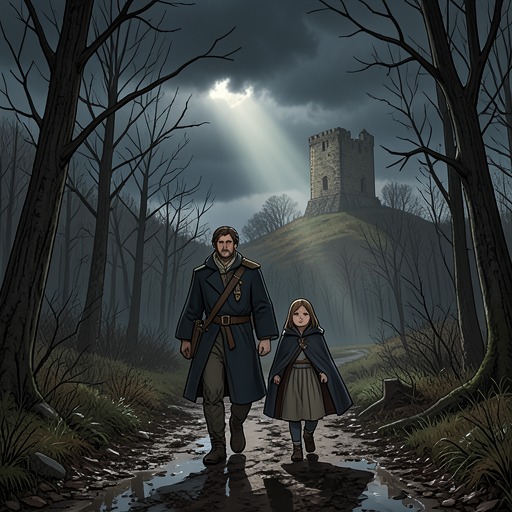
The road eventually turns sharply through the forest, and a break in the trees reveals the monastery’s long, low walls and the square summit of its massive tower. Beyond the ruins, snow-capped mountains rise above an immense black valley. Claudia extinguishes the lantern and instructs Louis to close his eyes briefly before looking again, making the discovery of the monastery feel like a controlled passage from ordinary perception into a supernatural space. She leads him forward quietly, as though their bodies have lost weight, toward an opening in the walls.
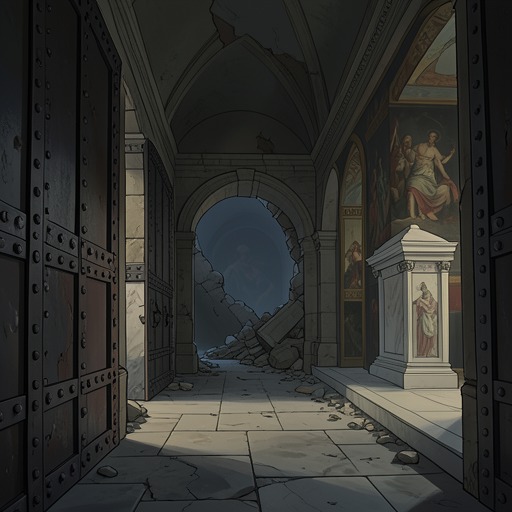
Inside, the ruin is open to the sky. Damp stone, vines, darkness, a vast staircase, and narrow windows overlooking the valley establish it as both architectural remnant and threshold. Claudia becomes almost motionless among the stones while she listens. Beneath the first rise of the stair they find a broad, hollow-sounding stone, evoking the villagers’ earlier opening of a grave. The sound that follows does not come from the ruin itself but from the hill leading up from the village: scraping, then the measured tread of approaching feet. The monastery is thus presented as a place where burial, pursuit, and revelation converge.
The Vampire in the Ruins
The approaching figure is carrying a human being. It pauses as though stroking the person, and Louis steps into the moonlight without knowing what to say. The figure’s eyes shine, and its sharp canine teeth catch the light. It attacks Louis with fetid breath, clawlike fingers, and an iron grip, while Claudia strikes it with stones and screams behind it. Louis and Claudia fight the creature across the stones until they force it down.
The revelation is more horrifying than the attack. Louis discovers that he is not struggling with a secret master or an ancient teacher but with an animated corpse: huge eyes bulge from naked sockets, the nose has become two small holes, leathery flesh encloses the skull, and the rags covering the body are thick with earth, slime, and blood. Claudia drops a sharp stone onto its forehead, and a second blow shatters its bones. The creature’s chest still throbs briefly before its arms shudder and become still. In the monastery’s moonlit ruin, the supposed European vampire is killed by the same brutal physical methods described in the books Claudia has been reading.
The human victim is Morgan, who has survived the journey to the monastery but lies motionless nearby. Louis initially forgets him in the exhaustion and stench of the struggle, then recognizes that Morgan is still alive and that dawn is less than an hour away. The ruin therefore preserves no stable boundary between witness and victim, living traveler and buried corpse, or vampire and decomposing body. Each category collapses into the next.
Failed Revelation and Eastern European Pattern
The encounter at the monastery destroys the expectation that Eastern Europe contains superior or more knowledgeable vampires. Louis and Claudia continue through Transylvania, Hungary, Bulgaria, and other regions where peasants believe that the living dead walk and vampire legends remain abundant. When they find vampires, the pattern is almost always the same: mindless corpses with wagging heads, weakened shoulders, rotted clothing, and no secrets to disclose.
In one village they pursue a female vampire who has been dead only a few months. Her burial gown is stained with dried blood, her fingers are packed with grave dirt, and her eyes are empty pools reflecting the moon. She offers no explanation of vampiric existence, only despair. The monastery’s creature is therefore not an isolated aberration but the clearest instance of a recurring condition. The ruins reveal the truth of the regional legends while denying Claudia the knowledge she seeks.
Louis interprets this discovery through his fear that he and Claudia may have killed the only other vampire capable of conscious existence: Lestat. The decayed beings in the ruins and surrounding villages make Lestat’s apparent destruction seem plausible, even though Louis cannot reconcile their mindlessness with the intelligence and will Lestat possessed. The landscape becomes a field of comparison in which Lestat’s former charms and limitations return to Louis’s thoughts. Instead of freeing him from the past, the search makes him think of Lestat constantly.
Narrative and Thematic Significance
The ruins near the monastery mark the collapse of an Old World quest. Claudia seeks a shared origin, a community, and a body of ancient knowledge; Louis seeks broader understanding while remaining doubtful that the damned can teach the damned anything meaningful. The monastery offers the physical atmosphere of antiquity—tower, valley, snow peaks, graves, and ruined stone—but its supernatural inhabitant has no wisdom commensurate with the age of the place. Antiquity survives as architecture and folklore, not as a living tradition capable of answering them.
The location also concentrates the book’s recurring imagery of contamination and failed purification. The vampire emerges from earth and rot, attacks through blood, and is destroyed by shattered bone and stone. The villagers’ staking and beheading practices, recorded in Claudia’s books, are repeated in altered form by Louis and Claudia’s violent struggle. The ruin is not cleansed into a sacred refuge; it remains a damp, open, lifeless enclosure where the ancient and the diseased are indistinguishable.
After the encounter, the larger journey becomes emotionally barren. The vampires they find across Eastern Europe repeat the monastery’s condition, and Louis’s hope of instruction gives way to despair. Claudia ultimately argues that they have done everything wrong from the beginning and that they must go to Paris, where they might find their language and their people. The ruins near the monastery thus function as the negative center of the quest: they are the place where the search reaches its most concrete answer and discovers that the answer is silence, decay, and the absence of any higher vampire knowledge.